
How to Stop Doomscrolling at Night (Without Willpower Alone)
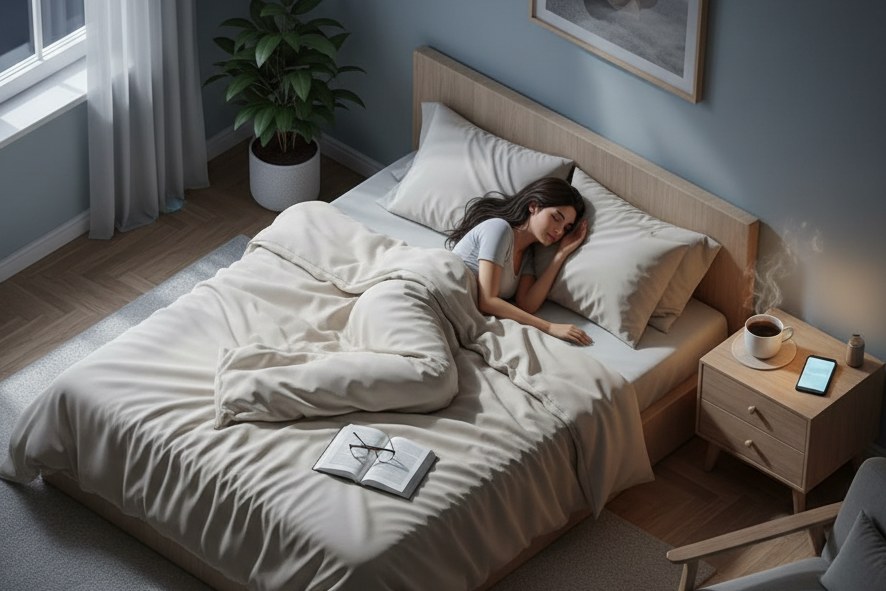
Night doomscrolling rarely starts as a “bad habit.”
More often, it starts as a comfort-seeking move.
You’re tired. Your day finally gets quiet. Your brain wants something familiar—something that feels like “staying on top of things,” or at least something to hold onto for a moment. So you check the news. Or your feed. Or “just one more” update.
And then it’s 1:12 a.m.
If this happens to you, you’re not broken. You’re human.
And you don’t need willpower alone to change it.
This guide is about designing a gentler night system—so sleep has a real chance.
1) Why doomscrolling gets stronger at night
At night, three things often line up:
Your brain is depleted
When you’re tired, the part of the brain that manages self-control and decision-making is simply weaker. That’s not a flaw—it’s physiology.
Uncertainty feels louder
In the dark and quiet, worries can echo. Checking feels like a way to “get certainty,” even when it doesn’t actually calm you.
Feeds are engineered to continue
Infinite scroll, autoplay, breaking alerts, emotionally hot content—night is when those designs become especially sticky.
So if you’re asking, “Why can’t I stop?”
A kinder answer might be: You’re trying to soothe yourself with a tool that keeps you activated.
2) The goal isn’t “never scroll.” It’s “protect sleep.”
A gentle boundary can be more sustainable than a strict rule.
Try this framing:
“I can read tomorrow. Tonight, I protect my sleep.”
Sleep isn’t just rest—it’s emotional regulation, clarity, resilience, and kindness to your future self.
3) Step one: reduce entry points (make autopilot harder)
If you do only one thing, do this.
Night doomscrolling often depends on frictionless entry.
Choose one or two:
Remove news/social apps from your home screen (keep them, just hide them)
Log out of the apps you fall into most
Turn off breaking/news alerts (especially at night)
Use Focus / Do Not Disturb after a set time
Charge your phone outside the bedroom (even across the room helps)
This isn’t punishment. It’s design: turning “one tap” into “two steps.”
4) Step two: create gentle night rules (simple, few, realistic)
Pick two rules, not ten.
Too many rules become another form of stress.
Here are gentle options:
Time rule
- “No feeds after 10:30 p.m.”
(or choose your time)
Place rule
“Phone stays off the bed.”
“No phone in the bedroom.” (if possible)
Temperature rule
- “At night I only read low-heat content: summaries, calm essays, no live updates.”
Sequence rule
- “If I open my phone, I do the reset first.” (we’ll define this below)
Rules work best when they’re kind and repeatable.
5) Step three: give your brain a softer alternative
Most doomscrolling is meeting a need:
comfort
distraction
connection
certainty
stimulation
emotional processing
So it helps to replace the habit with something that meets the same need—more gently.
Here are calm swaps:
If you’re seeking certainty
write one sentence: “What am I afraid will happen?”
then answer with one sentence: “What’s one thing I can do tomorrow?”
If you’re seeking comfort
warm drink
hot shower
soft blanket + slow breathing
If you’re seeking connection
send one caring message to one person
read one saved note or letter (something steady, not reactive)
If you’re seeking stimulation
a short chapter of a familiar book
a calm podcast episode (no autoplay if possible)
a simple puzzle
The point is not “perfect calm.”
It’s “less activating than a feed.”
6) A short night reset (2 minutes)
This is a tiny ritual you can do when you notice the pull.
The 2-minute reset
Pause (put the phone face down)
Exhale slowly 3 times
Name it: “I’m looking for comfort.”
Choose one: sleep-support action or tomorrow-plan action
Sleep-support actions (choose one):
drink water
bathroom + back to bed
stretch for 30 seconds
dim the lights
Tomorrow-plan actions (choose one):
write the first step for tomorrow
set one reminder
park the worry in a note: “I’ll revisit this at 11 a.m.”
This reset doesn’t “fix your life.”
It breaks the trance.
7) When you slip: how to return without shame
If you doomscrolled again, the goal is not guilt.
Guilt often pushes you back into the feed.
Try this instead:
close the app
whisper: “It makes sense. I’m tired.”
do a micro-reset (water, bathroom, lights down)
return to bed
A gentle return teaches your brain: “I can come back.”
8) A simple setup you can try tonight
If you want a one-night plan:
turn on Do Not Disturb at a fixed time
move one high-pull app off your home screen
put your phone to charge away from your pillow
choose one replacement (book / music / shower)
use the 2-minute reset if the urge hits
That’s enough. Small steps count.
Closing: you’re not weak—you’re tired
Night doomscrolling isn’t a character problem.
It’s often a tired nervous system reaching for a familiar loop.
So let’s give your nervous system something kinder:
fewer entry points
gentle night rules
a softer alternative
a short reset
and a shame-free return
You can protect your sleep without relying on willpower alone.
And your future mornings will feel the difference.